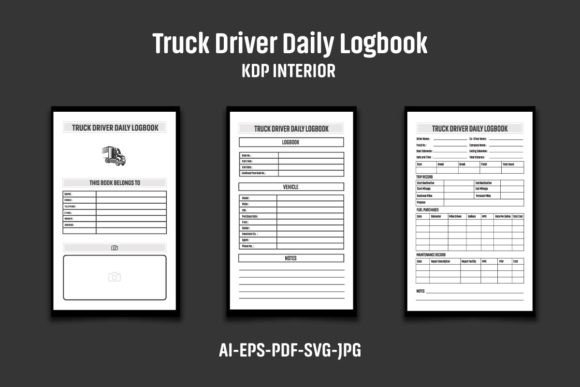
Truck Driver Daily Logbook KDP Interior
First Impressions: Clean, Functional, and Quietly Confident
Opening Truck Driver Daily Logbook KDP Interior feels like flipping through a well-worn notebook — not flashy, but purpose-built. The layout is grounded in utility: clear section headers, ample white space, subtle grid lines, and legible, no-nonsense typography. There’s no decorative flourish just for the sake of it. As an embroidery designer who’s stitched everything from nursery monograms to boutique apron sets, I immediately sense this isn’t a “look-at-me” graphic — it’s a quiet workhorse. It leans into its theme without cliché: no cartoon trucks, no exaggerated chrome, no oversized steering wheels. Just clean structure, professional spacing, and a visual rhythm that says “I belong on something made to last.”
A Real-World Test: Embroidering This on a Heavy-Duty Cotton Tote
Last week, I prepped a custom embroidered tote for a small logistics startup — durable 14-oz canvas, black base fabric, meant for daily use by drivers and dispatchers. I chose Truck Driver Daily Logbook KDP Interior as the central design element, scaled to fit a 5” x 7” hoop. The result? Crisp, readable, and surprisingly warm. The text remained legible even at 8-point equivalent size in stitch form, thanks to generous letter spacing and bold, consistent stroke weight. No vanishing serifs or fragile crossbars — just sturdy, functional letterforms that translate cleanly into satin and fill stitch. Customers noticed the difference: one driver told me, “It doesn’t look printed — it looks *earned*.” That’s the handmade product effect you want.
Where It Shines (and Where It Needs Thought)
Truck Driver Daily Logbook KDP Interior works beautifully for:
- Custom apparel — especially sweatshirts, structured caps, and denim jackets where clarity and durability matter
- Embroidered patches — its flat, borderless layout adapts easily to merrowed or heat-seal backing
- Tote bag design and apron embroidery — the balanced proportions hold up across wide, stable surfaces
- Personalized gifts for trucking families — think baby onesies (“Future Driver”), kitchen towels, or holiday stockings
- Boutique branding — pairs well with minimalist shop tags, packaging inserts, or staff uniforms
But proceed with care on:
- Small hoop sizes (<5”) — fine details like log timestamps may compress or blur; always test at target scale
- Stretchy fabric — the tight grid lines and narrow column dividers need solid stabilizer support to avoid wobble
- Dark fabric — while the design itself has strong contrast, verify thread colors for readability (e.g., light gray text on navy needs off-white or pale yellow thread)
- Curved surfaces like structured caps — avoid placing dense text blocks over crown seams where distortion can occur
- Frequent-wash items — confirm stitch density allows for flexibility without puckering; high-fill areas benefit from lightweight tear-away + cutaway combo stabilizer
Design Integrity Meets Commercial Practicality
This isn’t just another digital embroidery file — it’s a thoughtfully composed design asset. As a craft business owner, I value how it supports brand consistency: whether used on a single embroidered patch or scaled across a full line of printable mockups, the tone stays professional and grounded. For Etsy sellers and small shop owners, that reliability builds customer trust. Buyers don’t just buy a truck-themed graphic — they buy confidence that the item will look intentional, not generic. And because Truck Driver Daily Logbook KDP Interior avoids over-decoration, it leaves room for your own voice: pair it with a custom border, add a small embroidered star or route number, or layer it subtly beneath a name tag.
What Every Embroidery Designer Should Do Before Stitching
Before committing thread and time:
- Test on scrap fabric — same weight, same color, same stabilizer combo you’ll use for the final piece
- Check thread color contrast in natural light and under store lighting — what reads clearly on screen may fade on dark cotton
- Review stitch density — if the interior includes fine grid lines or tight text blocks, ensure your machine handles them smoothly at speed
- Confirm hoop size compatibility — especially if adapting for caps or curved garments
- Inspect small details — zoom in on any timestamp placeholders or divider lines to ensure they’re stitchable, not just vector-thin
- Test black-and-white mockups — helps spot unintended visual weight imbalances
- Compare light vs. dark fabric backgrounds — some layouts gain authority on black, others breathe better on cream
- Use proper stabilizer — medium-weight cutaway is safest for structured items; lightweight tear-away works for tea towels or baby items
- Verify licensing — since this falls under Kdp Interiors and Graphics, confirm whether the files permit commercial embroidery of finished products or resale of digital assets
Final Thought: A Design That Earns Its Place
Truck Driver Daily Logbook KDP Interior won’t win awards for flash — and it shouldn’t. Its strength is in restraint, readability, and real-world resilience. It’s the kind of machine embroidery design that disappears into the product just enough to feel native, yet remains unmistakably intentional. Whether you’re stitching a personalized gift for a new CDL graduate, building a cohesive line of trucking-themed merchandise, or sourcing reliable design assets for your digital product shop, this interior delivers quiet professionalism — exactly what serious makers and their customers expect.